Leadership Series Explores the “Cosmic Coast” with Dr. Mike Perry of Columbia Southern University

Leadership Series Explores the “Cosmic Coast” with Dr. Mike Perry of Columbia Southern University
Perry challenges South Baldwin business leaders to recognize that nearly every industry is becoming “space-adjacent” and to prepare today’s workforce for tomorrow’s opportunities.
The future of the space economy may seem hundreds of miles above us, but according to Dr. Nathaniel “Mike” Perry of Columbia Southern University, its impact is already much closer to home.
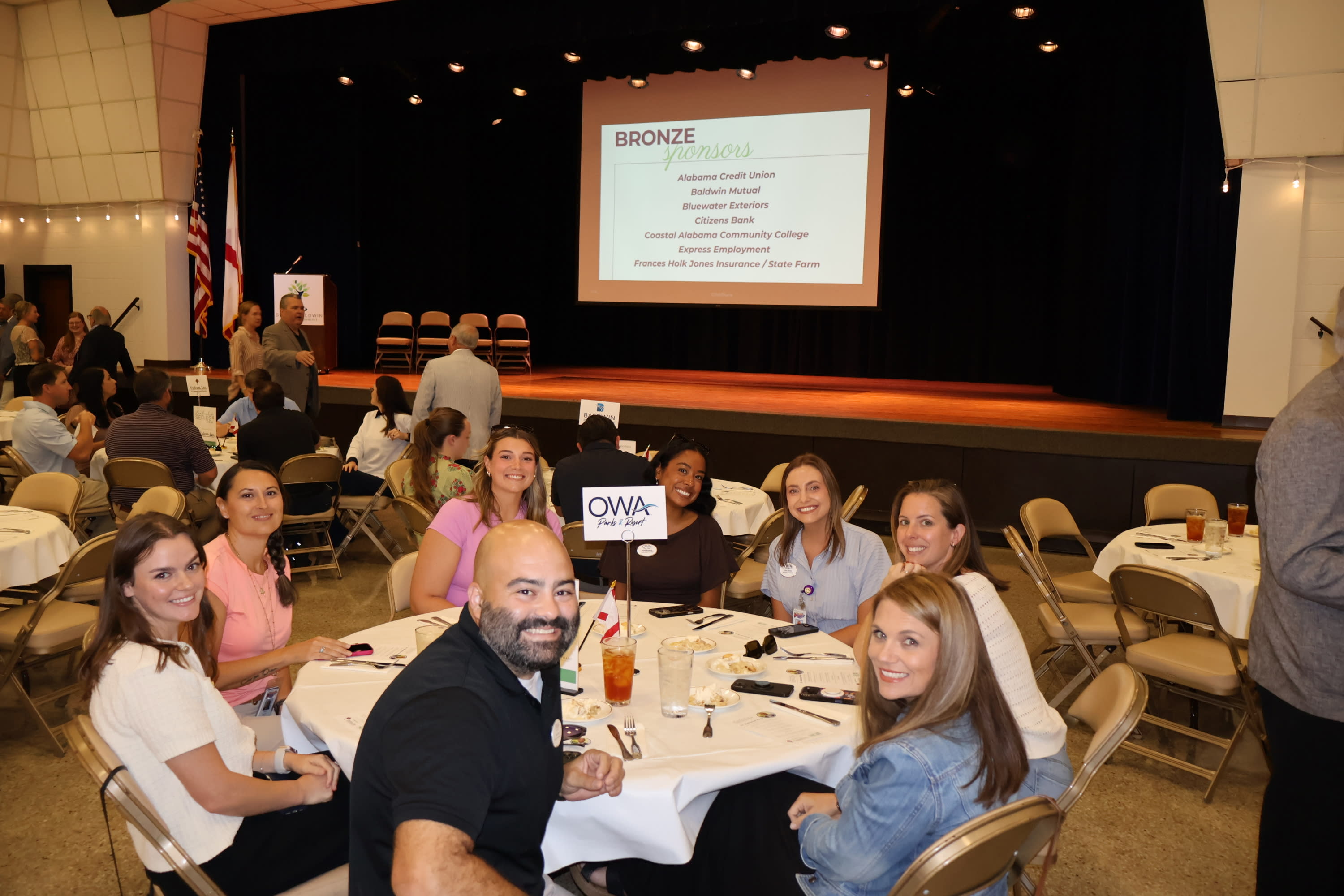
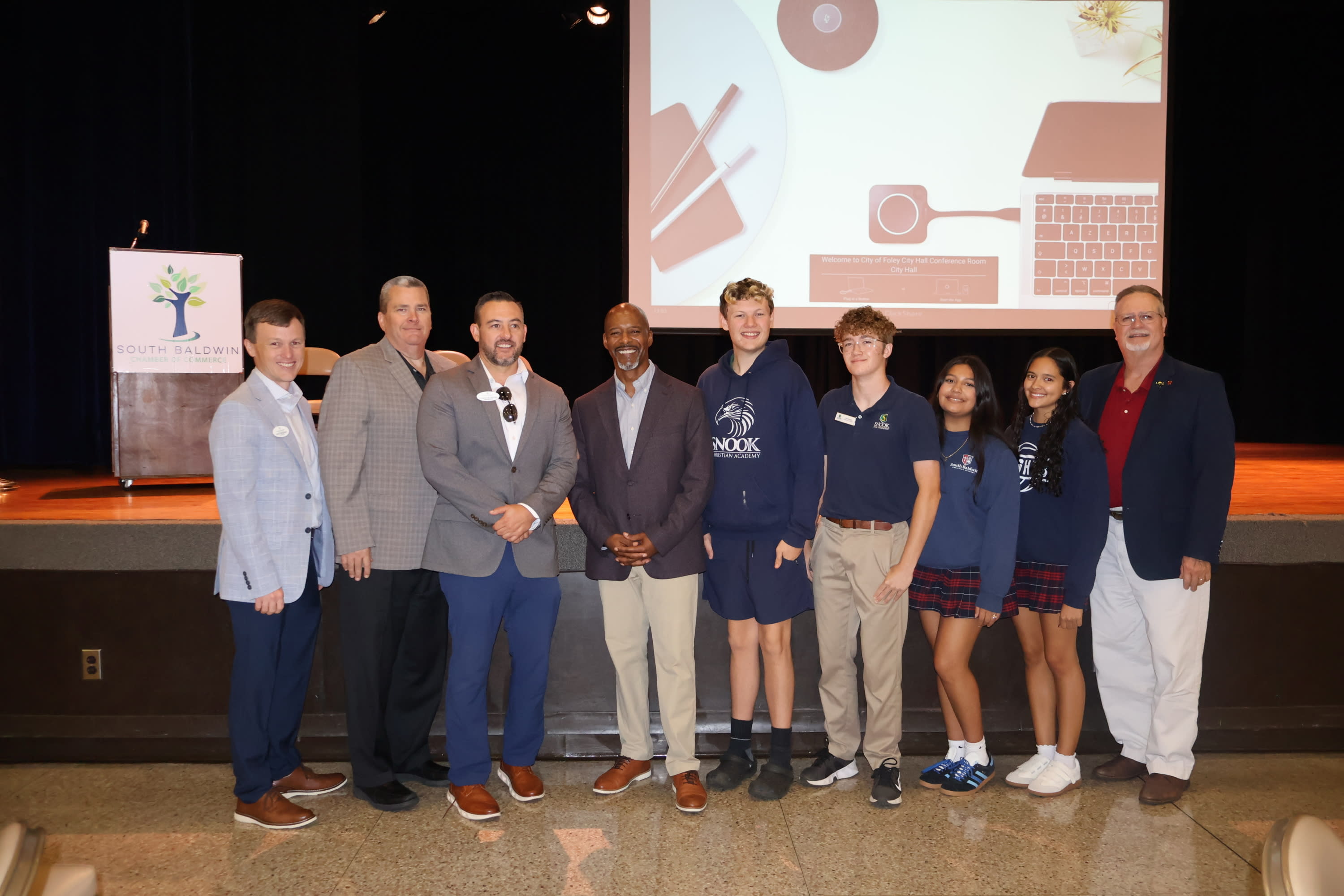
The South Baldwin Chamber of Commerce welcomed members, business leaders, educators, and community partners on September 23 for its latest Leadership Series luncheon, presented by Vulcan, Inc. The program featured Perry, Dean and Assistant Provost of the College of Space, Intelligence, & Military Operations at Columbia Southern University (CSU), presenting “The Cosmic Coast: Forging the Future of Space Exploration.”
Presented by Vulcan, Inc., the Leadership Series is one of the South Baldwin Chamber’s premier programs, designed to keep members informed, engaged, and connected to the issues shaping our region. Hosted eight times each year, these luncheons feature respected and influential speakers who bring insight on timely topics impacting our business community.
From economic development and tourism to local governance, workforce development, and state-level initiatives, each program delivers relevant, real-world perspectives that attendees can take back to their businesses and organizations. Just as important, the Leadership Series provides valuable opportunities to build relationships with fellow professionals, civic leaders, and key decision-makers from across South Baldwin County.
Every Business is Becoming Space-Adjacent
A central message of Perry’s presentation was simple but significant: the space economy is no longer limited to rockets, astronauts, aerospace manufacturers, or companies traditionally identified as part of the “space industry.”
Instead, space-based technologies are increasingly woven into everyday business operations.
Positioning, navigation, and timing signals support logistics, banking, agriculture, and transportation. Earth-observation data is used in insurance, real estate, energy, and environmental compliance. Satellite connectivity supports healthcare delivery, retail, manufacturing, communications, and other industries.
As these technologies become standard business tools, Perry explained that the distinction between a “space business” and other industries will continue to blur. In time, nearly every business could be considered space or space-adjacent.
That shift is occurring alongside tremendous growth in the global space economy. Perry’s presentation highlighted projections showing the industry approaching $2 trillion by 2035, along with growing private investment, commercial activity, satellite deployment, and global participation in space operations.
For business leaders, Perry reframed the question from whether their company should enter the space sector to whether their workforce has the space literacy needed to understand and capitalize on the opportunities already emerging around them.
Space Literacy: Preparing the Workforce We Already Have
Workforce development was at the center of Perry’s message.
As the space economy grows, demand will extend far beyond aerospace engineers and scientists. Perry pointed to opportunities for skilled technicians, mission-support personnel, satellite communications specialists, space operations managers, logistics coordinators, policy and compliance analysts, business strategists, and other professionals.
Many of these positions combine familiar skills with a new understanding of how those skills operate within a space-enabled economy.
The opportunity, therefore, is not necessarily to build an entirely new workforce. It is to upskill and reskill the workforce already here.
For employers, Perry encouraged viewing space literacy as an operational readiness investment rather than simply a hiring challenge. Building an understanding of space operations and space-enabled technologies among existing employees can help businesses recognize new opportunities, adapt to changing industries, and compete as space-based capabilities become increasingly integrated into the broader economy.
Why the Gulf Coast is Positioned for Opportunity
Perry also made the case that Alabama and the Gulf Coast already possess many of the ingredients necessary to compete in this growing economy.
Alabama has a longstanding connection to the nation’s space program through NASA’s Marshall Space Flight Center in Huntsville, along with an established aerospace manufacturing, research, engineering, and defense ecosystem. U.S. Space Command’s planned relocation to Redstone Arsenal further strengthens Alabama’s position within the national space and defense landscape.
Closer to home, Baldwin County brings its own strengths to the equation.
The region has an established workforce and growing industries in manufacturing, defense, logistics, healthcare, and education—all sectors Perry identified as having the potential to increasingly intersect with space-enabled operations. Educational institutions throughout the region are also producing technical graduates and providing pathways for working professionals to develop new skills.
Perry’s message was that the Gulf Coast does not lack capability. The opportunity is to connect those existing strengths through a more deliberate and coordinated talent pipeline.
CSU: Building a Talent Pipeline for the Space Economy
Columbia Southern University is positioning its College of Space, Intelligence, & Military Operations and Space Operations program as part of that regional workforce solution.
CSU’s goal is to develop professionals who understand the many facets of space operations and can carry that knowledge into a wide range of industries—not only traditional aerospace careers.
Through partnerships with employers, CSU can work with businesses and organizations to develop micro-credentials, certificates, and degree pathways relevant to emerging workforce needs. With flexible learning options designed for working professionals, employees can develop new capabilities while remaining in the workforce.
Perry outlined three recommendations for regional business leaders: upskill and reskill the current workforce toward greater space literacy; partner with educational institutions to help shape the talent pipeline; and deliberately position the Gulf Coast as a space-friendly, innovation-oriented economy.
The potential payoff extends beyond individual businesses. A coordinated approach could create a stronger supply of qualified space operations professionals, establish continuous learning opportunities for the workforce already living here, and strengthen the Gulf Coast’s identity as it competes for future investment, businesses, and talent.
Connecting Business, Education and Community
The South Baldwin Chamber extends its sincere appreciation to Vulcan, Inc., Presenting Sponsor of the 2026 Leadership Series, for its continued investment in bringing influential speakers and relevant conversations to the South Baldwin business community.
The Chamber also thanks Warren Averett, Education Enrichment Sponsor, for its continued support of educational opportunities through the Leadership Series and its commitment to connecting future leaders with the people, industries, and ideas shaping our region.
Guests enjoyed a buffet lunch catered by Jim ‘N Nick’s Community BBQ while networking with fellow Chamber members, business professionals, and community leaders.
As part of the Chamber’s ongoing effort to provide greater visibility to its nonprofit partners, Baldwin Education Coalition was featured as the program’s Community Spotlight. The Leadership Series provides participating nonprofit partners with an opportunity to host a display table, mingle with attendees, and share information about their mission and impact throughout Baldwin County.
The South Baldwin Chamber remains committed to connecting its members with influential leaders and meaningful conversations that drive progress. Dr. Perry’s presentation offered a different perspective on what the future could hold for South Baldwin—one in which the opportunities created by the space economy reach far beyond traditional aerospace companies and into businesses throughout our community.
As Perry’s message underscored, the space economy is not simply something coming in the future. Many businesses are already part of it. The opportunity now is to make sure our workforce is prepared for what comes next.
Connect with Columbia Southern University
Businesses and organizations interested in exploring workforce partnerships, customized learning opportunities, or CSU’s space-related programs are encouraged to connect with the Columbia Southern University team:
Dr. Mike Perry
Mike.Perry@columbiasouthern.edu
Mimi Henning
Mimi.Henning@columbiasouthern.edu
Debra Newton
Debra.Newton@columbiasouthern.edu
See event photos in our Flicker Album
Images